

There is a specific kind of silence that exists at 14,000 feet above sea level in the Himalayas just before dawn. The kind that isn’t empty — it’s full. Full of everything the noise of daily life drowns out. It was in that silence, on a mountainside in Spiti Valley, that I understood something that no book had ever been able to teach me: travel is not about the places you go. It is about who you become in the going.
I have visited more than multiple countries and 100 plus cities. I have broken a world record. I have written books about the journey. And if someone asked me today to distill everything I have learned from a lifetime of travel into its most essential truth, it would be this: the most transformative trips are not the ones where you see the most — they are the ones where you are most present.
That is what mindful travel means to me. Not a trend, not a hashtag, not a wellness retreat that costs $3,000 a week. Mindful travel is a way of moving through the world with intention, curiosity and gratitude. It is available to every traveller, on every budget, in every destination. And it changes everything.
Here are the 10 lessons and mindful travel tips that a lifetime of travel have taught me about how to truly experience the world.
“Travel is not about the places you go. It is about who you become in the going.” — Shivi Goyal
Lesson 1: Slow Down More Than You Think You Need To
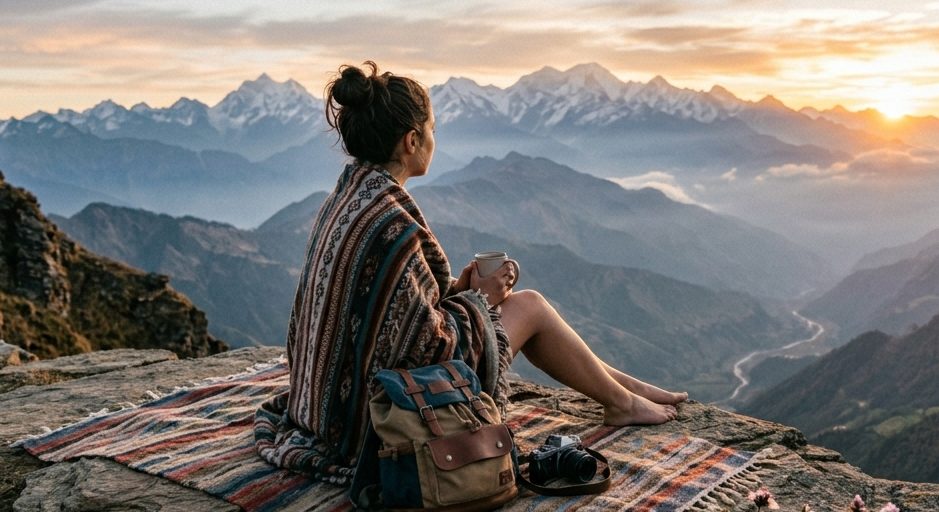
The greatest mistake I made in my early years of travel was trying to see everything. Five cities in seven days. Twelve countries in a month. I have the photographs to prove I was there. I have almost no memory of actually being there.
The turning point came on a trip to Japan. I missed a connecting train and was forced to spend an unplanned afternoon in a small town called Kurashiki. I wandered into a canal-side cafe, ordered tea I couldn’t name, and sat for two hours watching the town go about its day. It is the most vivid travel memory I have from that entire trip.
The lesson: your itinerary is not a checklist. Give yourself permission to miss things. The things you find when you’re not looking are always the best ones.
🌿 Mindful travel practice: When you arrive in a new place, spend the first hour doing nothing. Just sit. Watch. Let the place come to you before you go to it.
Lesson 2: Put the Camera Down (Sometimes)
I say this as someone who has documented thousands of travel moments — some photographs are worth taking. But the reflex to photograph everything is the enemy of experiencing anything.
I remember standing at the edge of the Grand Canyon at sunset, watching a man spend the entire experience trying to get the perfect selfie. The canyon was turning gold and pink behind him and he never once simply looked at it. I wanted to gently take his phone and put it in my pocket on his behalf.
The world record I broke was documented thoroughly. But the moment it happened — that moment belongs only to me. It exists nowhere online. And it is the moment I return to most often.
- Rule I follow: For the first 10 minutes in any extraordinary place, no camera. Just presence.
- Exception: Fleeting moments — street scenes, interactions, expressions — photograph first, experience after.
- The test: If you’re adjusting the angle more than you’re feeling the moment, put it down.
Lesson 3: Learn Three Words in Every Language
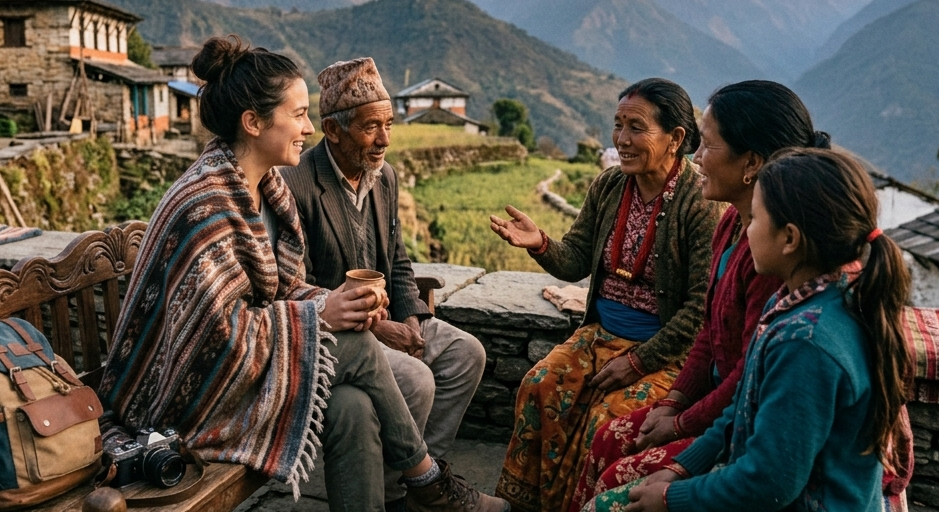
Hello. Thank you. Delicious.
These three words, in the local language of wherever you are, will open more doors than any guidebook ever written. I have had entire friendships begin with a badly pronounced ‘Arigato’ in Japan, a stumbling ‘Merci beaucoup’ in Morocco, and a completely mispronounced ‘Dhanyavaad’ in Uttarakhand that made a shopkeeper laugh so hard she gave me an extra serving of chai.
Language is respect made audible. When you try — even badly — to speak someone’s language, you are saying: your culture matters to me. I am not here to make you adapt to me. I am here to meet you where you are. The response to that gesture is almost always warmth beyond what any tourist experience could manufacture.
🗣️ Mindful travel practice: Before every trip, learn Hello, Thank you, and one food word in the local language. Write them on a card in your wallet. Use them on day one or whenever needed.
Lesson 4: Eat Where There Are No Menus in English
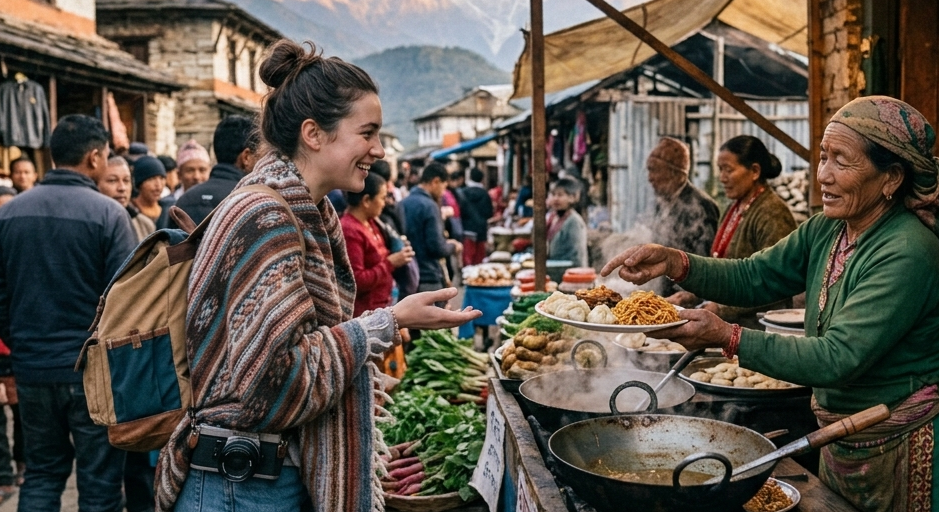
The restaurant with the laminated menu, the photographs of every dish, and the word ‘TOURIST’ written in invisible ink across the entrance — I have eaten in these places. We all have. They are fine. They are also completely forgettable.
The meal I remember from every trip is the one where I pointed at something I couldn’t name and said yes. The bowl of soup in a Vietnamese market at 7am that cost less than a rupee and tasted like the entire history of a culture in one broth. The thali in a Rajasthani dhaba where the owner kept refilling my plate without asking because that is simply what you do. The fish fry at a Kerala toddy shop where I was the only foreigner and the most welcome person in the room.
Food is the fastest way into a culture’s soul. Eat where the locals eat. Order what they’re having. Be willing to not know exactly what you’re putting in your mouth. You will almost never regret it.
The meal I remember from every trip is the one where I pointed at something I couldn’t name and said yes.
Lesson 5: Travel With a Question, Not Just an Itinerary
Before one of my most memorable trips, I decided to travel with a question instead of a plan. The question was: ‘What does happiness look like in different cultures?’
That question changed everything about how I travelled. I noticed things I would have walked past. I started conversations I would never have had. In Japan, happiness looked like precision and ritual — a perfectly made cup of matcha, a garden raked into perfect lines. In India, it looked like noise and colour and togetherness — fifteen people at a table, everyone talking at once, food everywhere. In Iceland, it looked like silence and space and the northern lights appearing unannounced.
None of these was the right answer. All of them were true. And I came home changed in ways that a list of tourist attractions could never have managed.
✈️ Mindful travel practice: Before your next trip, write one question you want to explore. Let it guide what you notice, who you talk to, and what you remember.
Lesson 6: Get Lost on Purpose
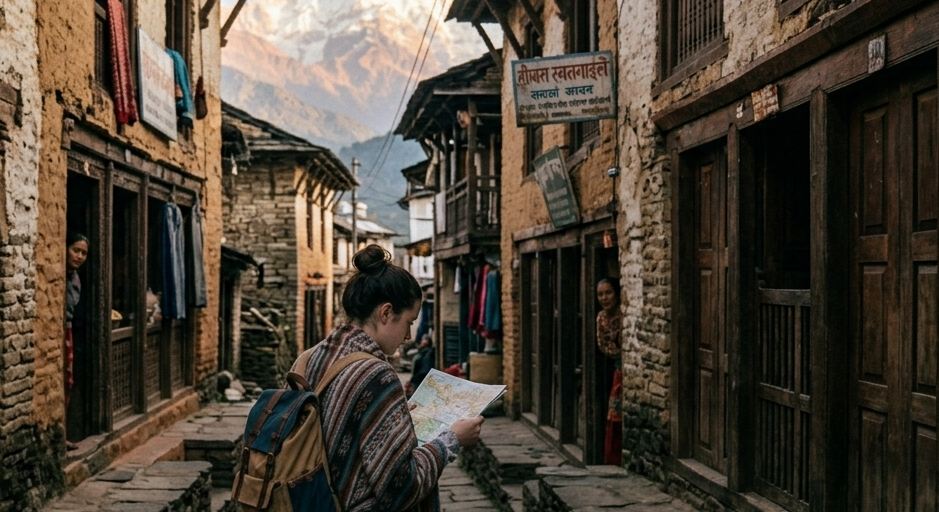
Not dangerously lost. Not in an unfamiliar city at night. But deliberately, joyfully lost in the middle of the day in a neighbourhood that has nothing in the guidebook.
I have a rule when I arrive in a new city: on the first morning, I walk in a direction that has nothing on my itinerary and I walk for one hour. No destination. No map on my phone. Just walking and looking.
This practice has given me: a rooftop chai with a retired schoolteacher in Varanasi who told me about Partition. A street mural in Lisbon that stopped me completely for twenty minutes. A waterfall in Himachal Pradesh that I would never have found if I hadn’t taken the wrong path and been too stubborn to turn back. A festival in a small Karnataka village that no travel site had ever mentioned.
The algorithm cannot take you where getting lost can. That is the whole point.
Lesson 7: Stay Longer in Fewer Places
This is the lesson I most wish I had learned earlier.
There is a version of travel that is essentially trophy collecting — I went here, I saw that, I can cross it off. I did this version of travel for years. It gave me a very long list of places visited and a surprisingly shallow understanding of any of them.
The shift happened when I spent three weeks in one small town in Rajasthan instead of three days. By week two, the shopkeepers knew my name. I had a favourite table at a rooftop restaurant where the owner would save it for me. I understood the rhythm of the town — when it was quiet, when it came alive, what it sounded like at 5am and at midnight. I had, in some small way, lived there rather than passed through.
That depth of experience is not available to the tourist. It is only available to the traveller who stays.
🌿 Mindful travel practice: On your next trip, take one place off your itinerary and give that time to a place you’re already visiting. Go deeper, not wider.
Lesson 8: The World Record Taught Me This — Preparation Is an Act of Respect
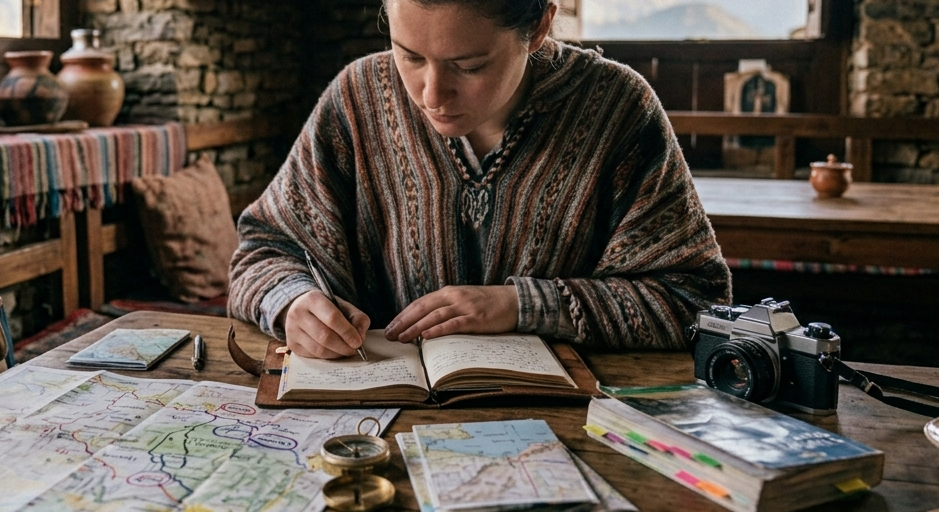
Breaking a world record requires extraordinary preparation. Months of research, physical training, logistics, contingency planning. Every detail matters because in record-breaking, as in most things worth doing, the preparation is what makes the moment possible.
Travel is the same. Researching a destination’s history before you arrive is not a chore — it is respect. Understanding the cultural norms before you enter a temple, learning what the festivals mean before you photograph them, knowing why a place matters to the people who live there before you pass judgment on it — this is what separates travel from tourism.
When I arrived at the monasteries of Spiti having read about the Tibetan Buddhist traditions they preserve, I saw things I would have walked past if I hadn’t known what to look for. The preparation was not separate from the experience. It was the experience.
- Before every trip: read one book set in or about the destination — fiction or non-fiction
- Research one historical event that shaped the place you’re visiting
- Learn one cultural practice — how to greet people, what not to do in sacred spaces, what the food means
Lesson 9: Discomfort Is Where the Growth Is
The best travel experiences of my life were uncomfortable at the time.
The 36-hour train journey in an unreserved compartment from Mumbai to Chennai that I took as a young traveller — sweaty, crowded, nowhere to sit for the first eight hours — during which I had conversations with twelve strangers that I still think about today. The trek in the rain when I was cold and exhausted and completely certain I had made a terrible mistake, right up until the valley appeared through the clouds and I understood that you can only earn certain views.
Comfort is wonderful. Comfort is also, often, a ceiling. The trip where everything goes according to plan, the hotel is perfect, the weather is ideal — that trip will be pleasant. The trip where something goes wrong and you have to figure it out, rely on strangers, find reserves of patience or courage you didn’t know you had — that trip will change you.
You can only earn certain views. The discomfort is not the obstacle — it is the path.
Lesson 10: Bring Something Back That Isn’t in a Bag

Souvenirs are lovely. I have shelves of them. But the most valuable things I have brought back cannot be packed or unpacked.
A different relationship with time — learned in a country where nobody is in a hurry and everything still gets done. A deeper patience with uncertainty — learned on a journey where nothing went according to plan and everything turned out better than planned. A genuine, bone-deep understanding that the way I grew up doing things is one way, not the only way, and that every culture I have encountered has something to teach me about how to live.
This is what mindful travel gives you that no passport stamp can. It rewires something. It makes the world smaller in the best possible sense — not by making everywhere the same, but by making you feel connected to it all.
That is something I am most proud of. Not the one that came with a certificate. The one that lives in how I see the world.
Travel Mindfully — The World Will Give You Everything
You do not need to break a world record to travel mindfully. You do not need to visit multiple countries or trek in the Himalayas or eat unidentifiable soup in a Vietnamese market — though I enthusiastically recommend all of these things. I still have lot ot cover.
You need only to arrive with your eyes open, your phone occasionally in your pocket, and a genuine willingness to be changed by what you find. The world will do the rest. It always does.
Travel slowly. Travel curiously. Travel as if every place has something to teach you. Because it does.
💌 Did this resonate with you? Share the lesson that hit hardest in the comments — I read every single one. And subscribe to Spirited Blogger for weekly travel stories and guides from someone who travels with intention, not just a suitcase.