

Bheemkund – Mysterious water pool in India #incredibleindia
Originally published February 2021. Updated April 2026 with complete visitor guide, depth mystery, Tsunami connection, how to reach from Khajuraho and nearby places.
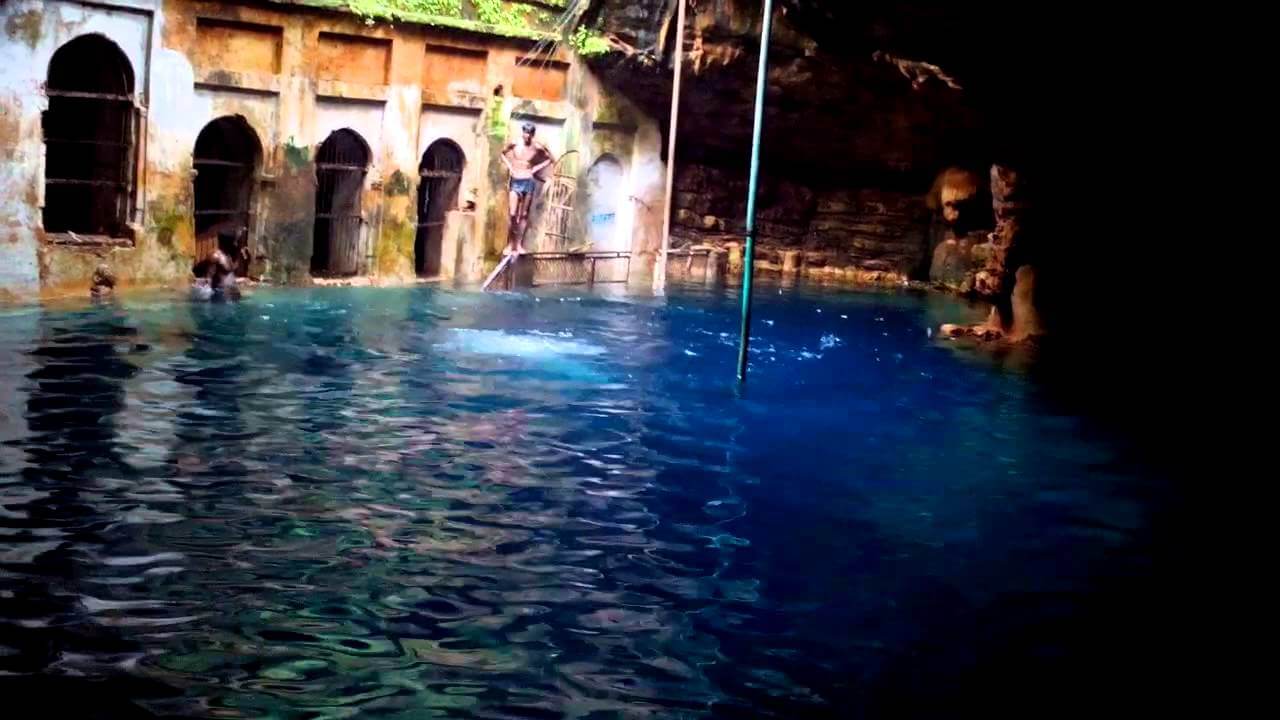
Let me tell you about the Tsunami first — because that is the detail about this place that nobody forgets, and it is the detail that tells you everything you need to know about how unusual Bheemkund actually is.
In December 2004, the Indian Ocean Tsunami struck thousands of kilometres away on the coast. Bheemkund — a landlocked water pool sitting in a cave in the Bundelkhand hills of Madhya Pradesh, connected to no ocean, no visible river, no known water source — responded. The water level jumped 30 feet. Ten-foot tides rose from the deep. The locals watched it happen. Scientists have no agreed explanation for why it occurred. The depth of the pool that caused those waves remains, to this day, unknown.
This is not a regular place.
| At a Glance | Details |
|---|---|
| Location | Near Bajna village, Chhatarpur district, Madhya Pradesh — in the Bundelkhand region |
| Distance from Chhatarpur | 77 km by road |
| Distance from Khajuraho | Approximately 80 km — the most common visitor base |
| What it is | A natural underground water pool (kund) set inside a cave, fed by an unknown source |
| Width | Approximately 20 metres |
| Depth | Unknown — no scientific measurement has reached the bottom. Estimates range from 80 to 300+ feet. |
| Water colour | Deep indigo blue — shifts shade throughout the day. Completely clear. |
| Entry fee | No entry fee |
| Timings | 9 AM to 6 PM |
| Also known as | Neelkund (Blue Pool), Bheemkund, Bhimkund — all spellings refer to the same place |
| Best time to visit | October to March. Avoid peak monsoon when access roads can flood. |
The Mystery of Bheemkund: Why Nobody Has Reached the Bottom
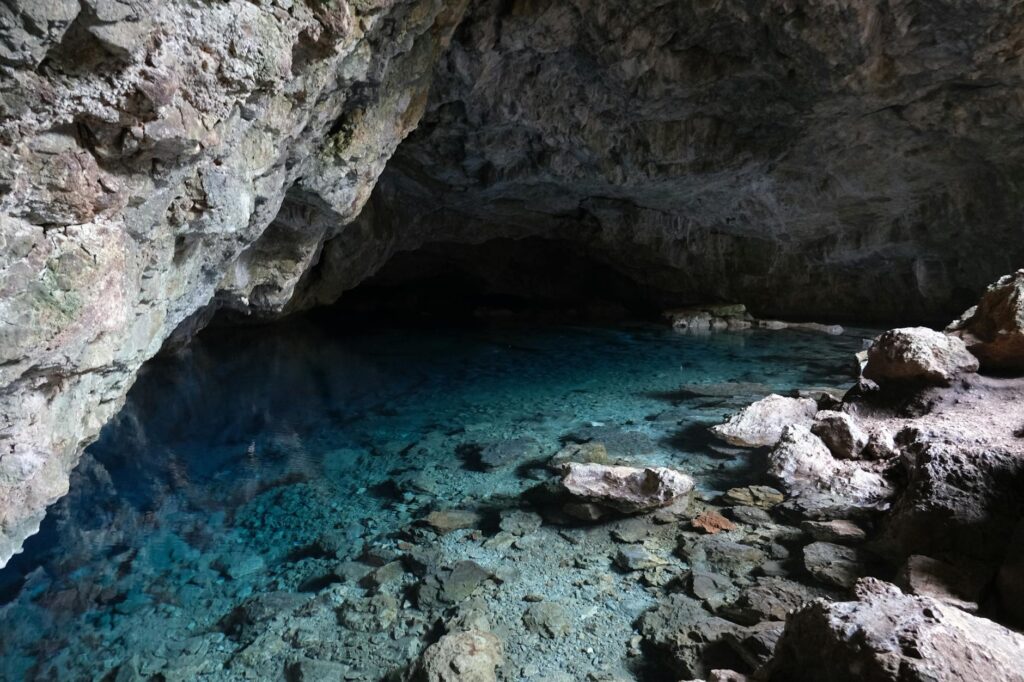
Bheemkund is called bottomless not as a figure of speech but as a statement of documented scientific failure. Although experts have repeatedly tried to measure its depth, they have yet to reach a conclusive result. As a result, the pool continues to challenge both science and imagination. Divers have explored it, scientists have investigated it, and advanced instruments have sounded its depths, but the answer remains elusive. None has returned a definitive answer. Estimates range wildly, from 80 feet to over 300 feet, and the nature of the water — its colour, its clarity, and its apparent connection to some larger underground system — suggests the pool may be part of a subterranean network that extends far beyond the cave walls.
The water is deep indigo blue. This is not the blue of a painted wall or a filtered hotel pool. Extreme depth and a unique mix of minerals give the water its remarkable blue hue, producing the same visual effect seen in some of the world’s most dazzling Alpine lakes and sea caves. Standing at the edge of Bheemkund and looking down, you can see fish moving in the clear water near the surface. Then the blue deepens and the floor simply does not appear. The pool is 20 metres wide. Its depth is a different question entirely.
The Mystery
The Tsunami response — the 30-foot water level surge in 2004 — is the strongest physical evidence that this pool connects to something much larger and much more distant than its cave setting suggests. Several geologists have theorised a connection to an underground river system that ultimately links to far-away coastal seismic activity. The theory has not been disproved. It has also not been proved. Bheemkund keeps its secrets.
There is a particular feeling you get when you stand at the edge of something genuinely unknown — not mysterious in the tourist-brochure sense, but unknown in the scientific sense, as in, nobody has successfully measured this. Bheemkund gives you that feeling. The fish swimming near the surface have no idea what is below them either. — Shivi Goyal
The Mahabharata Legend:
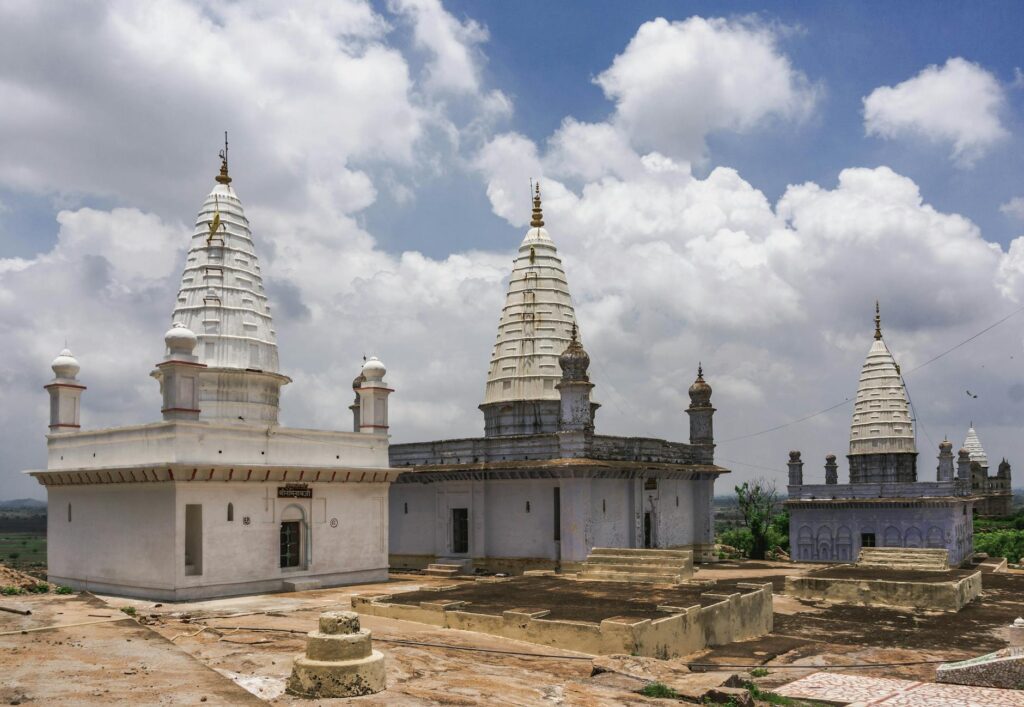
The name comes from Bhima — the second of the five Pandava brothers from the Mahabharata, and the strongest of them. The legend, as it is told in the Bundelkhand region and as it is inscribed in the physical features of the cave itself, goes like this.
During the exile of the Pandavas, the five brothers and their wife Draupadi wandered through the forests and hills of central India. The summer was relentless. Draupadi, weakened by the heat and the journey, fainted from thirst. Bhima — desperate, and capable of a kind of force that ordinary humans are not — struck the ground with his Gada, his iron mace. The earth cracked. Water poured up from below. The pool formed instantly and Draupadi drank, and was saved.
How Bheemkund Was Created
The physical details that support this story are visible today. The roof of the cave has a small circular opening directly above the pool — a hole that, when you look at it carefully, resembles the head of a Gada exactly as it would appear after being driven through stone from above. The locals point this out to every visitor. I looked at it carefully when I was there. It does.
To the left of the entrance passage, set into the cave wall approximately 3 metres from the mouth, is a Shivalinga. The cave is both a natural wonder and a sacred site, and it has been both for a very long time. Pilgrims come here for the legend and the sanctity. Travellers come for the blue water and the mystery. Both groups leave having found what they came for.
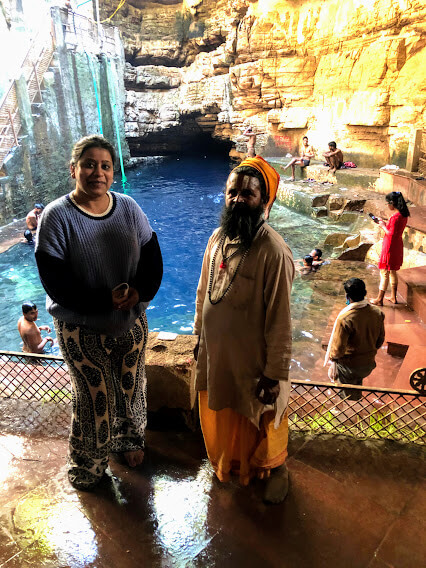
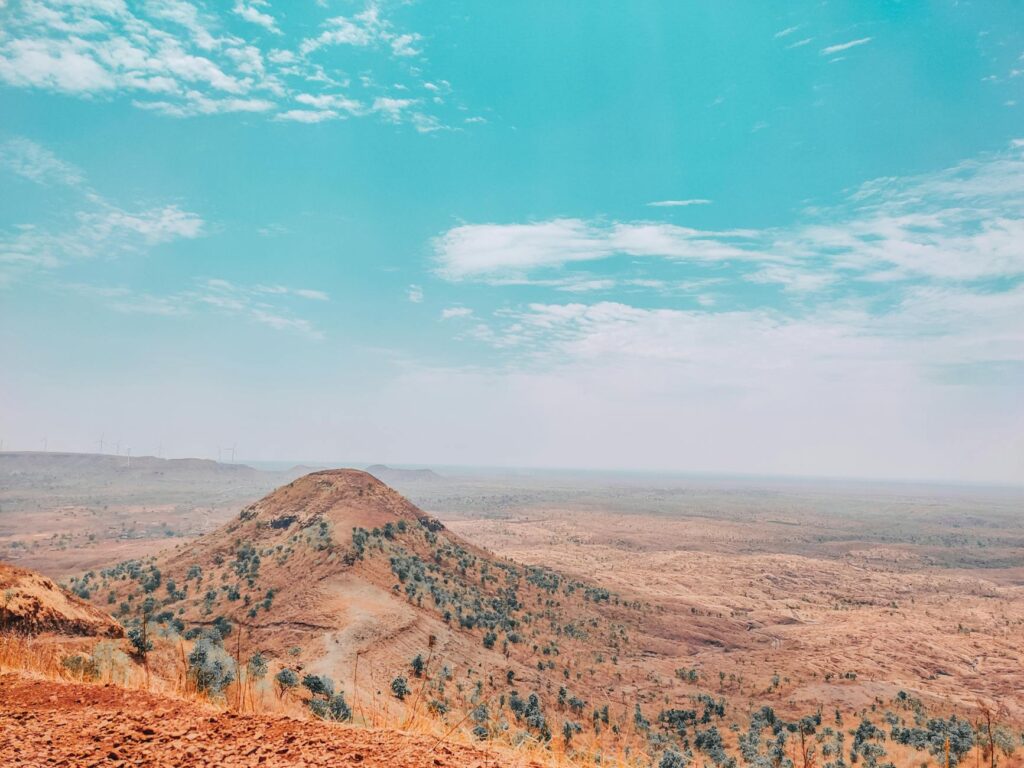
You approach Bheemkund through Bajna village. To begin with, the road into the area is unremarkable — dry landscape, scattered trees, the particular dustiness of the Bundelkhand interior. Yet nothing about the approach tells you what is coming. Indeed, there is no grand entrance, no large signboard, no infrastructure designed to impress. Eventually, you walk a short path, and then you are inside a cave.
What It Is Actually Like to Stand There:
At first, your eyes need a moment to adjust as you move from the bright outdoors into the dim cave interior. However, once they do, the pool immediately commands your attention. Surprisingly, its size is not what stops you. At 20 metres wide, it is substantial but not enormous. Nor does the cave ceiling draw your focus, despite the distinctive Gada-shaped opening above. Instead, the colour captures you first.
More specifically, the blue defies expectation. It is neither the cheerful blue of the sky nor the tropical turquoise often associated with clear water. Rather, it is a deep indigo, the slightly darkened blue of a depth that refuses to reveal itself. At the same time, the surface remains astonishingly clear. As a result, you can watch fish glide through the upper layers of the water with remarkable clarity. Yet as your gaze follows them downward, the transparency gradually gives way to blue. Eventually, that blue thickens, closes around the depths, and hides the bottom completely.
A First-Person Account (traveller’s view)
To the left of the entrance stands a small Shivalinga, its surface worn smooth by time. Typically, pilgrims leave flowers around it, and if someone has visited recently, you will often notice the lingering scent of incense. Beyond this sacred corner, the cave grows remarkably quiet. Unlike most outdoor spaces, it holds a distinct kind of silence. As the sounds from outside fade away, the gentle movement of water begins to dominate the space. Consequently, you hear little else, and the cave settles around you in a stillness that feels both deep and enduring.
I have visited places that people describe as mysterious and found them merely unusual. Bheemkund, however, remains genuinely mysterious. The tsunami connection is not a local legend. Scientists and observers documented the event. Likewise, the depth is not a romantic unknown but a scientific one. Divers, researchers, and measuring instruments have tried to uncover the truth, yet none have produced a definitive answer. When you stand at the edge of this pool, you stand before something that science still cannot fully explain. That is a rare and specific feeling, and it easily justifies the 80-kilometre drive from Khajuraho.
Bheemkund is one of the few places I have been where I found myself thinking about it differently a week later than I did standing there. The depth question keeps working on you. It is the kind of place that does not let you fully leave. — Shivi Goyal
How to Reach Bheemkund:
From Khajuraho — The Most Common Route (Recommended)
Khajuraho is the practical base for most visitors to Bheemkund. The distance is approximately 80 km, taking 2 to 2.5 hours by road. Hire a cab or private vehicle from Khajuraho — this is not a route with reliable public transport, and attempting it by bus involves multiple connections and uncertain timing. Most guesthouses and hotels in Khajuraho can arrange a day-trip cab to Bheemkund with waiting time for Rs 1,200–1,800 return, depending on negotiation. Include Panna National Park or Pandav Falls in the same day if your timing allows — they are in the same general direction.
From Chhatarpur
Chhatarpur is the district headquarters, 77 km from Bheemkund by road. Shared jeeps and occasional buses run towards Bajna village, from where Bheemkund is a short walk. Private cab from Chhatarpur is the more reliable option — Rs 800–1,200 return.
From Bhopal
Bhopal to Chhatarpur is approximately 330 km, taking 7 hours by road or roughly 6.5 hours by train (Mahamana Express from Bhopal to Chhatarpur). From Chhatarpur, arrange onward transport to Bheemkund. This makes Bheemkund part of a broader Madhya Pradesh trip rather than a standalone day trip.
Nearest Railway Station
Khajuraho railway station is the most convenient. Trains connect from Delhi (Khajuraho-Hazrat Nizamuddin Express, approximately 10 hours), from Bhopal (6–6.5 hours), and from Agra and Varanasi. From Khajuraho station, hire a cab to Bheemkund.
Nearest Airport
Khajuraho Airport — one of the smaller but more useful airports in Madhya Pradesh — operates flights from Delhi (IndiGo, Air India) and Varanasi. The airport is minutes from the Khajuraho town centre. From Khajuraho, arrange onward transport to Bheemkund as described above.
Information: Planning Your Bheemkund Visit
| Category | Details |
|---|---|
| Entry fee | Free — no entry charge to visit Bheemkund |
| Timings | 9 AM to 6 PM. Arrive before noon for best light inside the cave. |
| Best time of year | October to March — post-monsoon, cool and accessible. Avoid July–August when Bundelkhand roads can flood. |
| Time needed | 1–2 hours at the site is sufficient. Budget a full day with travel from Khajuraho. |
| Accommodation | No stay at Bheemkund itself. Stay in Khajuraho (wide range of options, 80 km away) or Chhatarpur (budget guesthouses, 77 km away). |
| Food | Basic local food available in Bajna village near the site. Carry water — it is a dry region. |
| Transport | Private cab from Khajuraho is the most practical option. No reliable public transport direct to the site. |
| What to carry | Water, light snacks, comfortable footwear (cave floor is uneven), torch or phone flashlight (cave interior is dim) |
| Photography | Photography is generally permitted. No flash photography at the Shivalinga out of respect. The pool photographs best from directly above — the colour difference between surface and depth is most visible from this angle. |
| Respectful behaviour | This is a sacred site as well as a natural one. Shoes are typically removed at the cave entrance. Do not disturb offerings at the Shivalinga. |
Nearby Places to Combine With Your Bheemkund Trip
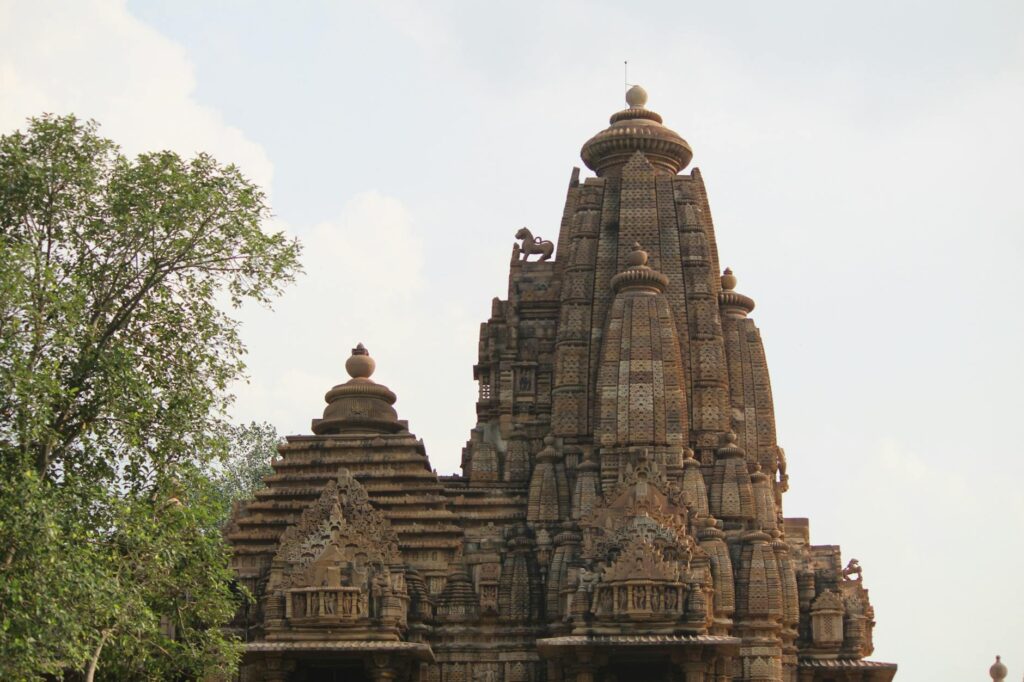
Khajuraho Temples — 80 km
The UNESCO World Heritage Site and one of the most extraordinary examples of medieval Indian temple architecture in existence. Built between 950 and 1050 CE by the Chandela dynasty, the temples are famous for their sculptural detail — erotic and otherwise — which represents a particular synthesis of spiritual and human experience that is unlike anything else in India. Most visitors base themselves in Khajuraho and do Bheemkund as a day trip. This is the right approach — Khajuraho deserves two days minimum on its own.
Panna National Park — 55 km from Khajuraho
One of India’s tiger reserves, on the banks of the Ken River. Panna was one of the great conservation success stories of the 2010s — tigers had been poached to local extinction by 2009, and a relocation programme rebuilt the population from scratch. It is now a functioning tiger reserve with good sighting rates. A morning safari from Khajuraho followed by an afternoon drive to Bheemkund makes for an exceptional full day.
Narada Kund — 2 km from Bheemkund
Another sacred water tank named after the sage Narada, who is believed to have meditated here. The water is considered to have medicinal properties by local tradition. Much smaller and more intimate than Bheemkund. Worth a short visit if you are already at the site.
Pandav Falls — 60 km from Chhatarpur
A waterfall in Panna National Park, named after the Pandavas who are said to have stayed here during their exile — the same exile that created Bheemkund. The mythological thread that runs through this entire region of Madhya Pradesh is worth following. The falls are beautiful in post-monsoon, when the Ken River is full.
Raneh Falls — 20 km from Khajuraho
A series of narrow gorge waterfalls on the Ken River, cutting through crystalline granite in shades of pink, red and grey. The gorge is 5 km long and visually extraordinary. Best in monsoon and early post-monsoon. Often combined with a Panna day trip.
Frequently Asked Questions: Bheemkund
What is Bheemkund and where is it located?
Bheemkund (also spelled Bhimkund or Bhimkund) is a natural underground water pool located near Bajna village in the Chhatarpur district of Madhya Pradesh, in the Bundelkhand region. It sits inside a cave, approximately 3 metres from the cave mouth, and is known for its deep indigo-blue water, unknown depth, and connection to Mahabharata legend. It is also called Neelkund (Blue Pool). The site is 77 km from Chhatarpur and approximately 80 km from Khajuraho.
What is the depth of Bheemkund?
The depth of Bheemkund is genuinely unknown. Multiple attempts to measure it — by divers and scientific instruments — have not produced a definitive answer. Estimates range from 80 feet to over 300 feet. The pool is believed by some geologists to connect to a subterranean river system, which would explain why the water level at Bheemkund rose dramatically during the 2004 Indian Ocean Tsunami — a seismic event thousands of kilometres away. The depth remains one of the most intriguing unanswered questions about this site.
Is there an entry fee for Bheemkund?
No — there is no entry fee to visit Bheemkund. The site is open to visitors daily from 9 AM to 6 PM. There are no ticketing or booking requirements. Basic facilities are available near the cave entrance in Bajna village.
How do I reach Bheemkund from Khajuraho?
Bheemkund is approximately 80 km from Khajuraho, taking 2 to 2.5 hours by road. The most practical option is to hire a private cab from Khajuraho for a day trip — most hotels and guesthouses in Khajuraho can arrange this. There is no direct public transport. The cab can include waiting time at Bheemkund and return in a single day.
What is the connection between Bheemkund and the Mahabharata?
According to local legend and oral tradition, Bheemkund was created by Bhima — the strongest of the five Pandava brothers — during the Pandavas’ exile. Draupadi fainted from thirst in the scorching Bundelkhand summer, and Bhima struck the ground with his iron mace (Gada), causing water to surge up from below and form the pool. The cave ceiling directly above the pool has a circular opening that resembles the impact point of a Gada, which locals point to as physical evidence of this event.
What are the best places to visit near Bheemkund?
The most worthwhile nearby destinations are Khajuraho temples (UNESCO World Heritage Site, 80 km — the standard visitor base), Panna National Park (55 km from Khajuraho, tiger reserve with good sighting rates), Narada Kund (2 km from Bheemkund, another sacred water tank), Pandav Falls in Panna (60 km from Chhatarpur), and Raneh Falls near Khajuraho (striking granite gorge waterfall).
Why Bheemkund Deserves More Attention Than It Gets
Most people who visit Madhya Pradesh go to Khajuraho and Orchha, maybe Bandhavgarh or Kanha for tigers, possibly Panna. Bheemkund appears on almost no one’s primary itinerary. It is off the beaten track in the way that places that have not yet been processed into an Instagram experience tend to be off the beaten track.
This will change. These things always do. The combination of the Mahabharata legend, the genuinely inexplicable depth, the colour of the water, and the Tsunami response is a story that would, if told well, generate significant interest. Right now it is quietly sitting in a cave in the Bundelkhand interior, visited primarily by pilgrims from the region and the occasional traveller who has done their homework about what else is within reach of Khajuraho.
I wrote about it in 2021 with 400 words and moved on. I am writing about it again now with significantly more because I think it deserves the attention, and because the question of what is at the bottom of that pool — a question that science has not answered and that keeps occurring to me at unexpected moments — feels like it warrants more than 400 words.
Go to Khajuraho. Spend two days with the temples. On the morning of your third day, hire a cab east and spend two hours with the most mysterious body of water in India. It is free, it takes no planning, and it is 80 kilometres from one of the most visited UNESCO sites in the country. The fact that more people do not go is mostly a failure of telling the story.
Consider this the story told.
“Bheemkund has no gift shop, no audio guide, no visitor centre. It is a cave with a pool of indigo water and a hole in the ceiling. It is also the only place in landlocked central India that responded to an ocean tsunami with a 30-foot wave. Both of these facts are simultaneously true.” — Shivi Goyal
Have you been to Bheemkund? Do you have a theory about the depth or the Tsunami connection? I want to read it in the comments. And subscribe to Spirited Blogger for honest travel writing about the places that deserve more attention than they get.
Also read on Spirited Blogger:
It’s hard to come by well-informed people on this topic, however, you seem like you know what you’re talking about! Thanks
I appreciate your kind words. Thank You.